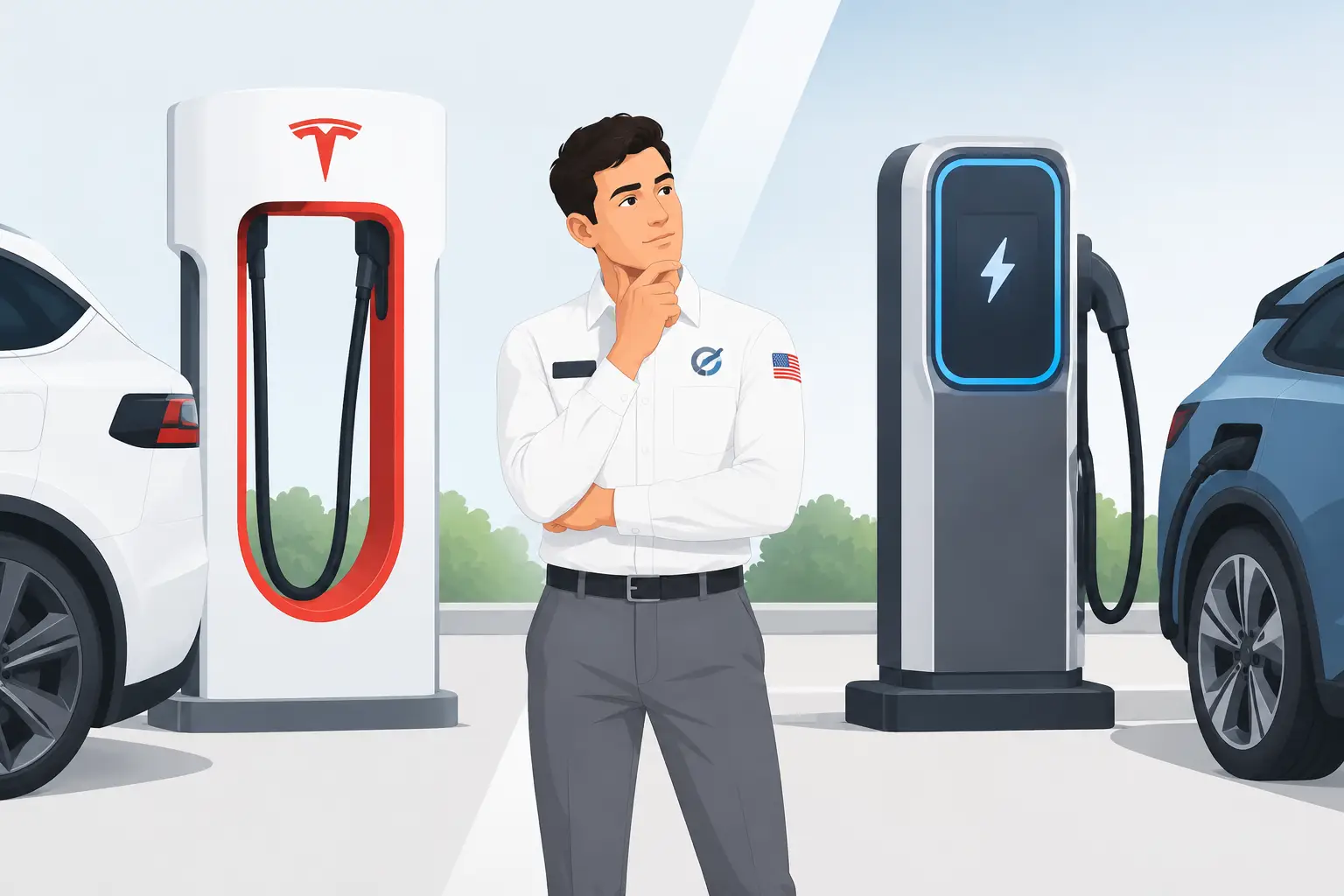
A Tesla charger versus universal charger decision affects more than the plug in your garage. It affects who can charge at your home, how easily you can change vehicles later, and what equipment your electrician needs to install safely. The best answer depends on the vehicle you drive now, the vehicles your household may own later, and your home’s available electrical capacity.
For many Southern Utah homeowners, a home EV charger is a practical upgrade. It replaces repeated trips to public charging stations with dependable overnight charging. But the charger should fit your household – not just today’s vehicle.
Tesla Charger Versus Universal Charger: The Main Difference
A Tesla-specific charger is designed around the connector used by Tesla vehicles. It provides a direct fit for those vehicles and can be a simple choice when everyone in the home drives that type of EV. A universal charger uses the common charging connector found on many electric vehicles. Some universal units may also support Tesla vehicles with the appropriate connector or adapter arrangement.
The distinction sounds small, but it can matter for daily use. A dedicated charger gives a Tesla owner a straightforward, direct connection. A universal charger gives a household more flexibility if another family member drives a different EV, a guest needs to charge, or a future vehicle purchase changes the mix in the garage.
Neither option is automatically better. The right equipment is the one that provides safe, reliable charging without creating unnecessary limitations for your home.
Start With the Cars in Your Driveway
If your household owns only Tesla vehicles and expects to continue doing so, a Tesla-specific charger can make sense. There is less to think about at plug-in time, and the equipment is built for that vehicle connection. It can be a clean, practical solution for a one-vehicle household or a garage dedicated to Tesla ownership.
A universal charger is often the stronger choice for households that have more than one electric vehicle type, plan to replace a vehicle in the next few years, or want charging access for visitors. It can also be a sensible long-term choice if you do not want your home’s charging setup tied to one vehicle connector.
Vehicle adapters can broaden compatibility, but they should not be the only factor in your decision. An adapter adds another piece of equipment to store, connect, inspect, and protect from damage. For occasional use, that may be perfectly reasonable. For everyday charging, many homeowners prefer the convenience of a charger that naturally fits the vehicles they expect to use most.
Think Beyond Your Current Vehicle
EV ownership can change quickly. A charger installed for one car may need to serve a second car, an adult child visiting for the weekend, or a replacement vehicle purchased several years from now. That does not mean every homeowner needs the most flexible option available. It means the installation should be considered as a home improvement with a longer life than the car currently parked in the garage.
A qualified electrician can explain the practical options before work begins, including where the charger will be mounted, how the cable will reach the vehicle, and whether your panel can support the planned charging load.
Charging Speed Depends on the Installation
It is easy to focus on the charger itself, but the home’s electrical system has a major role in charging performance. A faster-capable unit does not automatically charge at its maximum rate. Actual charging speed depends on the vehicle, the charger settings, the dedicated circuit, wiring size, breaker capacity, and the electrical capacity available in the home.
Most homeowners installing a Level 2 charger need a dedicated 240-volt circuit. This is not a standard outlet upgrade or a weekend DIY project. EV charging is a continuous electrical load, meaning the circuit and equipment must be selected and installed with that use in mind.
Your electrician may need to evaluate the main service panel before recommending a circuit size. In some homes, especially those with older panels or several major electrical loads, there may not be enough available capacity for the charger you want without additional work. Air conditioning, electric water heating, hot tubs, dryers, ovens, and other large appliances all factor into that calculation.
Trying to work around these limits with undersized wiring, overloaded circuits, or improvised connections can create overheating and fire risks. Safe charging begins with an installation designed for the home, not just the vehicle.
Location Matters More Than Most Homeowners Expect
The best charger on paper can be frustrating if it is installed in the wrong place. Before selecting either style, consider where the vehicle normally parks and where its charging port is located. The cable should reach comfortably without being stretched across a walkway, pinched by a garage door, or left where it can be damaged.
Garage installations are common, but outdoor charging can also be a good solution when designed for the conditions. Southern Utah heat, sun exposure, wind-blown dust, and occasional storms should all be considered when selecting a location and properly rated equipment. A professional installation helps protect the charger, the wiring, and the people using it.
For households with two EVs, placement becomes even more important. You may decide that one charger is enough if vehicles can alternate charging nights. Or you may need a plan that supports two charging locations while managing the home’s available electrical load. The answer depends on driving habits, battery needs, and the electrical system already in place.
Hardwired or Plug-In Charging Equipment
Many home charging units can be hardwired, while some are designed to connect through a properly installed receptacle. Both approaches can work when installed correctly, but they are not interchangeable shortcuts.
Hardwiring can provide a clean, permanent installation and eliminates the receptacle connection point. A plug-in unit may offer more flexibility if the homeowner plans to replace or relocate the charger later. However, the receptacle, circuit, breaker, wire size, and equipment rating still need to be matched correctly. A general-purpose outlet is not a substitute for an EV charging circuit.
This is one area where homeowners benefit from a clear, upfront conversation. The equipment choice, mounting location, circuit route, and panel condition should be evaluated together. That prevents surprises after the charger arrives and helps ensure the finished installation is ready for daily use.
When a Tesla-Specific Charger Is the Better Fit
A Tesla-specific charger may be the right choice when your home has one Tesla vehicle, the charger will be used primarily by that vehicle, and you value a direct plug-in experience. It can also make sense when future vehicle plans are clear and there is no need to accommodate other connector types.
The important point is that choosing a dedicated charger does not reduce the need for a professional electrical assessment. The charger still requires the correct dedicated circuit, proper overcurrent protection, suitable wiring, and a safe installation location.
When a Universal Charger Makes More Sense
A universal charger is usually worth considering when flexibility is a priority. It can be especially useful for mixed-EV households, homeowners who expect to change vehicle brands, or families who want to make charging available to guests.
It can also simplify the home’s long-term planning. Instead of replacing charging equipment after a vehicle change, you may be able to keep the same unit and adjust how it is used. Still, compatibility should be verified before purchase. Connector support, vehicle capabilities, cable length, and charging settings all deserve a closer look.
Choose the Charger After the Electrical Evaluation
The safest order is simple: decide how you want to use the charger, have the home evaluated, then select equipment that fits the installation. Starting with a charger purchase can sometimes lead to an avoidable problem, such as choosing a unit that requires more electrical capacity than the panel can safely provide.
Service Right Electric can diagnose your home’s current setup, explain the available options, and complete the work correctly with upfront pricing. Whether you choose a Tesla-specific unit or a universal charger, the goal is the same: dependable home charging that fits your vehicle, your garage, and your electrical system.
A well-planned charger installation should make every drive home easier – plug in, charge safely, and wake up ready to go.



0 Comments